Cold quadrants, hot terminal ends and unstable barrel temperatures do not automatically mean that the heater needs replacement. By mapping the temperature, checking electrical values, inspecting contact and separating machine faults from heater faults, you can identify the cause and order a compatible replacement when required.
Key takeaways
- Separate circumferential faults from axial temperature gradients first.
- Check voltage, resistance, terminals, clamping and sensors before replacing a band.
- Measure barrel diameter, heated width, voltage, wattage and terminal position.
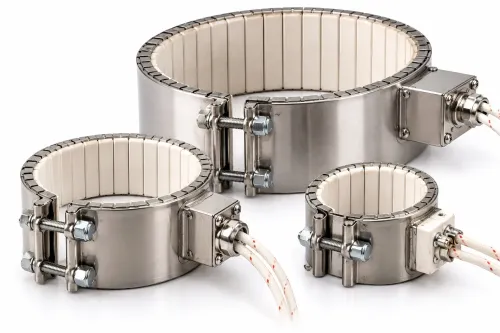
- Choose mica, ceramic or cast-in heating based on barrel condition and heat loss.
Find out whether the uneven heating is circumferential or axial
Start by deciding whether the gradient runs around the barrel or along its length. A cold strip beside a terminal or split suggests a local inactive section; a cold barrel end points to heater width, end heat loss, zone layout, or sensor position.
A loose band, poor clamping, oval or warped barrel, burrs, scoring, contamination, and air gaps cause poor contact and hot spots. Incorrect watt density, cracked mica, shorted turns, a bowed shell, loose L-clamps, or energising before tight clamping accelerates failure.
This is the core of mica band heaters for uneven heating in Pune and mica heater uneven heating diagnosis.
1. Map several axial and clock-position points with a calibrated contact probe, after stabilising each zone. Infrared readings on shiny stainless steel mislead unless emissivity and reflections are controlled. Check heater faults against blocked cooling channels, changing material residence time, barrel wear, lost insulation, die loading, and poor machine alignment.
| Symptom | Likely indication | Check |
|---|---|---|
| One cold quadrant | Air gap, warped barrel, or poor clamp | Contact and shell shape |
| One hot terminal | Loose connection or local resistance | Terminal and crimp |
| Whole dead zone | Open section or control fault | Zone continuity |
| Temperature overshoot | Sensor position or shorted turns | Sensor and resistance |
| Repeated controller cycling | Contact, heat loss, or process variation | Fit, insulation, and cooling |
Use a fault-finding sequence before blaming the band heater
Start industrial band heater troubleshooting by locking out power, cooling the barrel, and proving the circuit is dead before touching wiring.
- Record barrel temperature at several clock positions, then isolate and test each heating zone separately.
- Measure voltage and current at each heater terminal, not only on the controller display. Compare readings with the nameplate voltage, wattage and phase wiring.
- Estimate cold resistance with R = V²/P and running power with P = VI.
- Inspect terminal screws, crimps, lead exits, shorted or open sections and arcing marks.
| Check | Compare | Meaning |
|---|---|---|
| Voltage | Nameplate voltage | A mismatch changes heat output |
| Cold resistance | R = V²/P | Wrong wattage, open section or wiring fault |
| Running power | P = VI versus nameplate watts | Supply, connection or heater fault |
Correct element resistance does not prove safe insulation. Isolate the heater from PID controllers, SSRs, thermocouples and electronics before using an insulation tester, and follow the maker’s test limit.
Pune monsoon moisture can lower insulation resistance during storage. Dry the heater under controlled conditions; replace it if resistance remains low, mica is carbonised, or arcing or sheath damage appears.
Before replacing a PID, verify thermocouple type, controller operation and sensor mounting against the barrel or in a drilled hole. Poor sensor location can mimic mica band heater problems.
Measure the barrel and define the replacement before ordering
Measure the barrel at operating temperature before ordering a mica band heater replacement in Pune. A cold barrel measurement can produce a loose operating fit because thermal expansion increases the barrel outside diameter, reducing clamping pressure when the machine is hot.
1. Record barrel outside diameter at operating temperature, heater width, finished inside diameter or circumference, split or gap, clamping range, terminal style and position, available clearance, holes, cut-outs and thermocouple provisions.
2. Specify sheath material, voltage, total wattage, phase and required operating temperature. Matching only diameter and wattage can leave terminals, sensor access or clamp geometry incompatible with the machine.
3. Inspect the working surface. Acceptable contact is clean, close metal-to-metal contact around the barrel; an apparently tight band can still produce cold spots if the barrel is oval, scored, contaminated or thermally insulated from the band.
4. Do not increase watt density to cure slow heat-up. Correct contact, barrel insulation, zone control, supply voltage and heat loss first; extra watt density can create hot spots, damage residues and shorten mica life.
A replacement drawing should show the finished dimensions, split, terminals, holes, cut-outs, sensor access and clamping arrangement before fabrication.
Replace, commission and decide whether one band is enough
Lock out and tag out power, let the barrel cool, then photograph and document the old band’s dimensions, wiring, terminal positions and zone number. Remove leaked plastic, scale and other contamination; inspect for burrs, scoring, ovality, warping and air gaps before fitting the replacement.
- Install the band evenly around the clean barrel, close the split fully and support leads so cable weight does not pull on terminals.
- Energise only after full clamping; a loose band can develop local hot spots and destroy mica.
- After heat-up, retighten according to the heater design and machine manual, never an invented torque value.
- Retest every zone separately and check actual terminal voltage, current and temperature response.
Repeated failure at one terminal or lead exit points to hot ends, poor crimps, loose connections, unsupported cable weight, lead flexing or local heat shielding. Correct those causes before ordering another band. These are recurring mica band heater problems.
| Choice | Advantage | Risk |
|---|---|---|
| One replacement | Lower immediate cost and downtime | Different resistance, response time and heat loss can make it cycle unlike older bands |
| Adjacent pair or matched set | More consistent control | Higher replacement cost |
Add insulation blankets or barrel guards only after checking clearance. They reduce heat-up time and burn risk, but alter temperature readings; keep access open and prevent insulation from overheating terminals. For mica band heater replacement in Pune, specify the complete measured assembly, not just diameter and wattage.
Choose mica, ceramic or cast-in heating for the actual barrel condition
Choose mica for moderate-temperature, clean, dry service on a sound cylindrical barrel. Compare the complete construction, not the insulation material alone.
| Option | Response time | Maximum operating temperature | Damage, heat loss and fitting |
|---|---|---|---|
| Mica | Fast | Maker-specified for the full heater | Low mass and low heat loss; needs close contact; vulnerable to impact, gaps and moisture |
| Ceramic | Moderate to fast | Higher range only when the complete construction is rated for it | Better insulation and reduced heat loss; more tolerant of demanding heat duty, but brittle |
| Cast-in | Slowest response | Maker-specified for the casting, element and terminals | Durable, even distribution and low loss; exact geometry leaves little fitting tolerance |
Select ceramic when higher temperature or improved insulation matters. Select cast-in when geometry is stable and durable, even heating justifies longer replacement downtime. A mica band heater suits neither a barrel that cannot provide close contact nor direct liquid exposure.
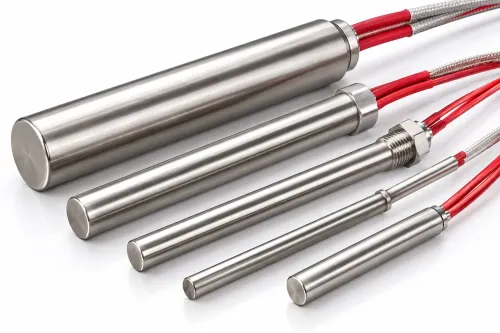
- Choose another design for very high temperature, severe vibration or impact, or when a cartridge, strip, ceramic or cast-in heater distributes heat better.
- Treat persistent mica heater uneven heating or mica band heater problems as a design warning, not a reason to increase watt density.
- Split long single zones: end losses increase with length. Independent zones help only after every sensor and wiring channel is correctly commissioned.
Compare Pune suppliers by evidence, not by wattage alone
A comparable quotation for mica band heaters for uneven heating in Pune starts with identical evidence: photographs of the installed band, terminals, split and barrel, plus width, diameter or circumference, voltage, wattage, phase, terminal style, clamp location, machine model, zone number and measured fault.
For mica band heater replacement in Pune, do not send only diameter and wattage.
Ask every supplier for a fabrication drawing showing dimensions, terminal position, cut-outs, thermocouple access, clamping range and wiring. Also request delivery lead time, site-measurement terms, emergency replacement support, post-installation testing and test results. Saket Enterprises 08048052723 can review an application when you provide these measurements instead of accepting a generic quotation.
| Finding | Better decision | Why |
|---|---|---|
| Correct heater current; faulty sensor, SSR, controller or loose terminal points | Repair wiring or controls | The band is receiving the expected load |
| Open resistance, damaged insulation or cracked mica | Replace the band | The heating circuit or insulation has failed |
| Bowed shell or repeated local arcing | Replace and inspect fit | Contact and electrical damage will recur |
Related product
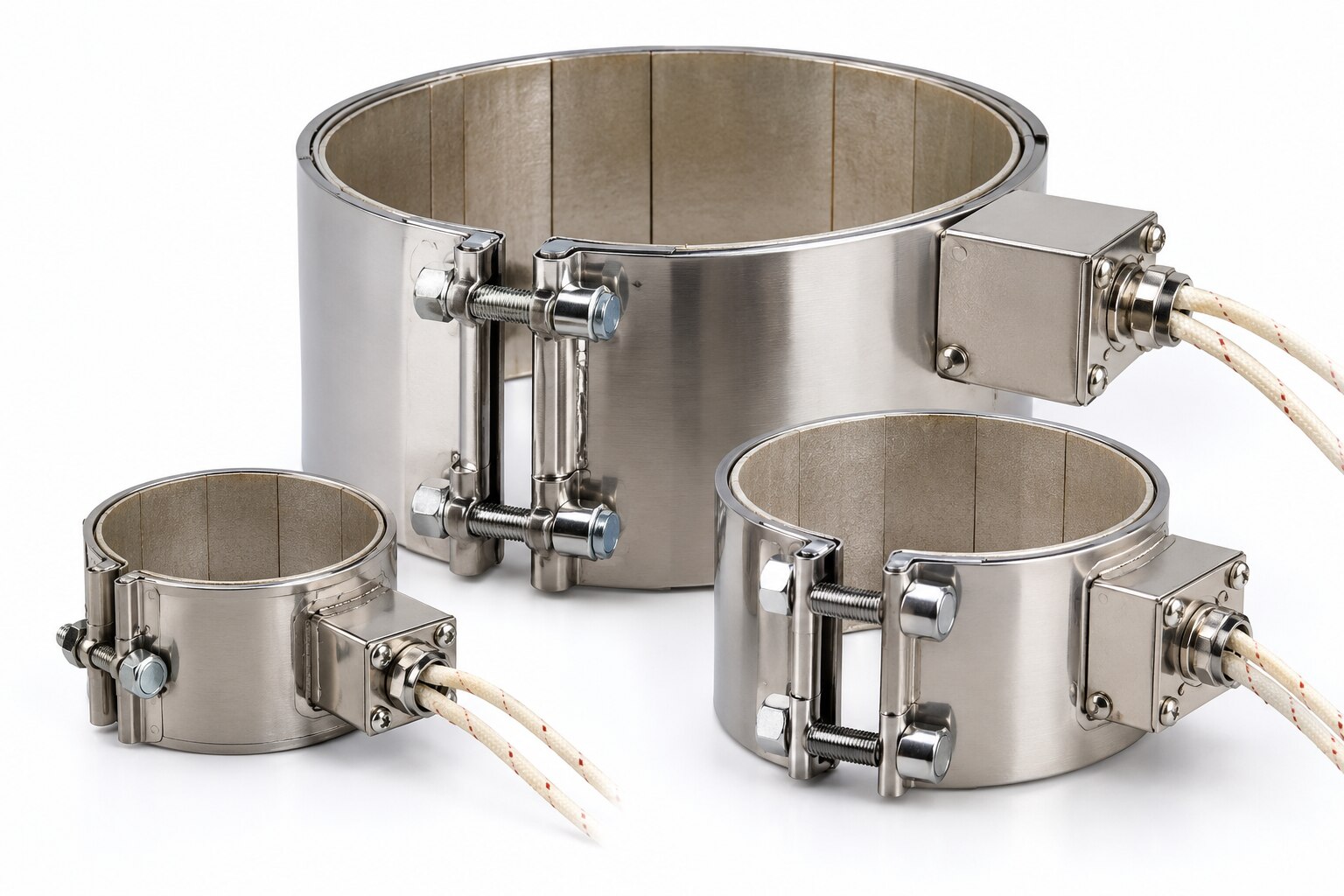
 | MICA BAND HEATERS Mica Band Heaters are built in 'MICA' Insulation with 'L' type clamping and manufactured in M.S. Plated sheet or S.S. outer & Brass inner sheet. View product → |
Frequently asked questions
How do you tell whether uneven heating is circumferential or axial?
A cold strip beside a terminal, split or inactive section indicates a circumferential fault. A cold barrel end indicates heater width, end heat loss, zone layout or sensor position.
What should you check before blaming a mica band heater?
Check supply voltage, element resistance, terminal tightness, insulation damage, heater fit, controller output, thermocouple position and barrel cleanliness.
What measurements are needed for a mica band heater replacement in Pune?
Record the barrel outside diameter, heater width, number of zones, operating voltage, wattage, terminal style and terminal position before ordering.
When is mica the wrong choice for a barrel heater?
Use ceramic when the barrel runs hotter or needs stronger insulation, and consider cast-in heating when you need a rigid, close-fitting heater with controlled heat transfer.
How should you compare suppliers of mica band heaters for uneven heating in Pune?
Compare drawings, resistance and insulation-test records, material details, terminal construction, fit guarantees, delivery scope and commissioning support instead of wattage alone.
Keywords