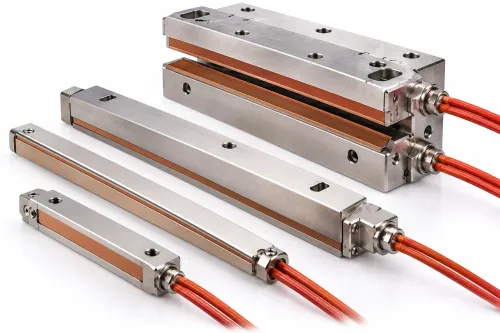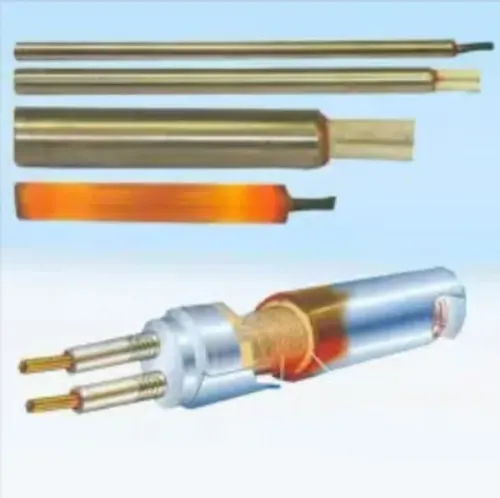
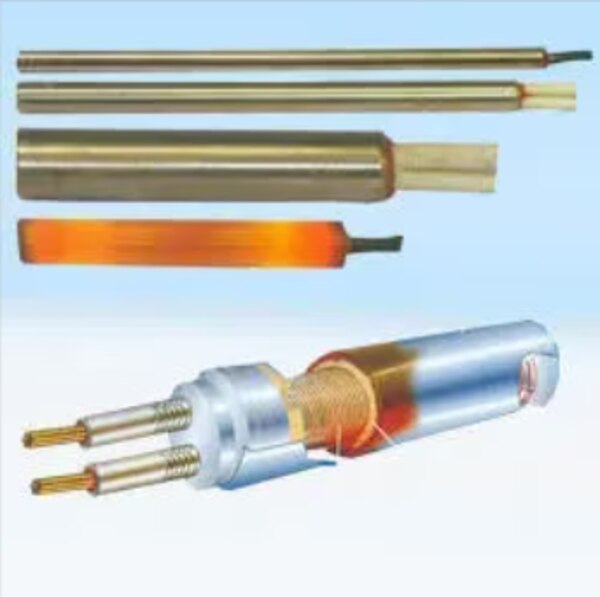
A bolt heater warms the steel through the bolt’s axial bore, allowing controlled expansion before tightening rather than heating the entire flange or joint. By the end, you will be able to define the bolt geometry, calculate the electrical load, set thermal limits, and request a complete drawing, test record and installation package.
Key takeaways
- Show bore diameter, heated length, cold length and overall heater length on the drawing.
- Calculate custom bolt heater power from voltage, current and required heating time.
- State target temperature, insulation, sheath material, leads and over-temperature protection.
- Compare Pune suppliers using drawings, test records, spares and delivery commitments.
What a bolt heater does during hot tightening
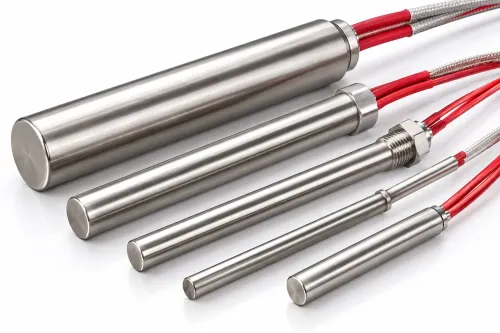
A bolt heater creates preload by heating the bolt through its axial bore, not by indiscriminately heating the surrounding joint. Its long industrial bolt heating element enters the hole and lengthens the required bolt section; you tighten the nut while the bolt is hot, then contraction during cooling develops the clamping force.
Bolt heater specifications must identify:
- Bolt grade and nominal diameter
- Drilled-hole diameter and depth
- Blind-hole or through-hole geometry
- Required heater insertion length
- Required final bolt temperature or measured elongation
- Tightening or preload method
The bore determines the heater’s outside diameter, heated length and safe insertion depth. A heater sized only from the thread diameter can be loose, seize in a damaged hole or bottom out in a blind hole.
Do not use maximum heater temperature as the preload specification. Bolt temperature differs from the nut, flange and gasket, and the permitted set point depends on fastener heat treatment, coating, lubricant, gasket material and adjacent equipment. Excessive heat can change fastener hardness, alter friction, damage the gasket or create fumes.
Never energize the heater in air, with partial insertion, inside a damaged bore or when it is jammed tightly. Stop and correct the fit first.
Which dimensions must appear on the bolt heater drawing
The drawing must show the heater against the measured bolt bore, not merely the bolt’s thread designation. Record the actual hole diameter and depth, identify a blind or through hole, and verify clearance for insertion and removal while the bolt and heater are hot.
Include these dimensional fields:
- Bolt diameter and bolt length
- Heated length and effective heated zone
- Hole diameter and hole depth
- Heater insertion depth
- Element outside diameter
- Exposed cold length
- Total heater length
Use this comparison to match the heater to the hole:
| Measured feature | Drawing value | Acceptance check |
|---|---|---|
| Hole diameter | Element outside diameter | Leave running clearance; reject a tight or damaged bore |
| Hole depth | Heated length and insertion depth | Keep the element off the blind-hole bottom |
| Bolt length | Total heater length | Confirm the head and cold section clear the joint |
| Joint surroundings | Flange and equipment clearance | Allow safe handling when hot |
A heater that bottoms out in a blind hole can overheat and fail rapidly. Specify a positive stop or insertion-depth mark, and state whether you must remove the heater without disturbing the joint.
Add the head or lead arrangement, terminal position, cable exit direction, lead length, minimum bend radius, and bend or flange-clearance requirements. Keep the cold section and terminal outside the hot zone, with enough space for safe handling; identify the required connector or gland and heat-resistant lead.
These details belong in bolt heater specifications, including for bolt heaters in Pune.
How to specify custom bolt heater power, voltage and current
Power, voltage and current are different entries on a bolt-heater schedule. Specify nominal voltage, phase, frequency, allowable voltage tolerance, rated wattage per heater, total simultaneous load and resistance at a stated reference temperature.
1. Calculate current as amperes equals watts divided by volts. Confirm that the site supply, controller, protective devices and cabling support the number of heaters energised together.
For industrial electrical heaters bolt heater for specifications in Pune, identify whether the site provides 230 V single-phase or 415 V three-phase, plus short-circuit protection, cable distance and inspection requirements.
2. Check voltage against fixed resistance using P = V²/R. A 415 V element connected to 230 V produces about 31% of its rated power; a 230 V element connected to 415 V is severely overpowered and can fail dangerously.
3. Estimate custom bolt heater power with P = (m × cp × ΔT ÷ heating time) + heat losses. Heating 10 kg of steel through 230 °C in 10 minutes needs about 1.8–2.0 kW before flange conduction, radiation, convection and control margin. A wattage without bolt mass, target temperature and heating time is incomplete.
4. Put the resistance value, reference temperature and serial number on the test record. Request insulation resistance, dielectric-strength, sheath-continuity or earth-bond, dimensional and heat-run results; test the assembly before dispatch and after installation when required.
Also state the cold-section length, terminal arrangement, cable-exit direction and lead temperature rating. A heater can meet its wattage yet fail when its terminal or lead insulation reaches flange temperature.
Which temperature, construction and safety details control performance
Set the target bolt temperature, maximum element temperature, permitted temperature spread across the heater set and validated warm-up time before selecting custom bolt heater power. Validate that time for bolt material, diameter, length and heat loss; closed-loop control produces more consistent preload than switching off after an elapsed time.
Specify the measurement and control system as follows:
- Use a surface thermocouple at the bolt head or an approved embedded sensor location; identify the controller type, alarm limits, independent over-temperature cut-out and heaters per control channel.
- Request resistance-wire material, mineral-insulation system, sheath alloy, ceramic grade where used, terminal insulation, resistance tolerance, heated length, cold length, lead insulation and lead-temperature rating.
- Match the sheath to operating temperature, oxidation, mechanical handling and chemical exposure. Add insertion interlocks or an insertion-depth mark where partial insertion could energise the heater unsafely.
| Measurement method | Specify | Risk controlled |
|---|---|---|
| Surface thermocouple | Clamp or bond it to the bolt head at the stated location; record contact method | A loose sensor reads air temperature |
| Infrared measurement | State surface emissivity, viewing distance, angle and measurement zone; use a calibrated instrument | Shiny steel can under-report temperature |
| Closed-loop control | Compare the sensor continuously with the set point and alarm limits | Elapsed-time switching creates uneven preload |
For inspection, request serial-numbered resistance, insulation-resistance, dielectric-strength, sheath-continuity or earth-bond, dimensional and heat-run results. Include the insulation-resistance acceptance value, dry-out temperature and retest method: mineral insulation absorbs moisture during storage, especially through Pune’s monsoon season.
What to include in a Pune bolt heater order and supplier comparison
A complete order package turns bolt heater specifications into a site-ready supply. For industrial electrical heaters bolt heater for specifications in Pune, state the available 230 V single-phase or 415 V three-phase supply, frequency, protection and short-circuit arrangements, ambient temperature, washdown conditions, hazardous-area classification, cable-routing distance and local inspection requirements.
Require these documents and quantities before approval:
- Approved dimensional drawing, electrical datasheet, wiring diagram, controller and sensor details
- Installation and removal procedure, including hot handling and lifting arrangements
- Inspection and test plan with serial-numbered resistance, insulation, dielectric-strength, earth-bond and heat-run records
- Calibration certificates for supplied sensors or instruments
- Number of spare heaters, storage packing suitable for long storage, and warranty terms
- The exact number of heaters per control channel and permitted temperature variation across the set
Write “heater only” when the supply excludes the controller, thermocouple, leads, clamps, lifting tools or installation accessories. Identify the bolt grade, coating, lubricant, allowable temperature, and tightening or preload method in the final order.
| Supplier comparison | Check | Reject or clarify |
|---|---|---|
| Dimensional scope | Drawing, hole fit and insertion depth | Wattage quoted without dimensions |
| Electrical scope | Load calculation, voltage, protection and control channels | Shared load not calculated |
| Construction | Material schedule and temperature limits | Generic material description |
| Quality evidence | Serial-numbered test records and calibration | Undated generic certificate |
| Commercial scope | Exclusions, spares, packing and warranty | Accessories assumed included |
When reviewing Saket Enterprises 08048052723 or another manufacturer, compare these records rather than wattage alone.
Related product
 | Bolt Heaters Product Details: Power As per customer requirement Type Cermaic Heater, Electric Heater, Fan Heater Fostered with a team of highly qualified... View product → |
Frequently asked questions
What does a bolt heater do during hot tightening?
It heats the bolt through its axial bore, lengthening the bolt so you tighten the nut before cooling creates preload.
Which dimensions belong on a bolt heater drawing?
Include bolt bore diameter, heated length, cold length, overall length, insertion depth, tip shape, lead exit and clearances.
How do you specify custom bolt heater power, voltage and current?
State the supply voltage, required current, wattage, heating time, target temperature and the number of heaters used together.
Which temperature, construction and safety details control performance?
Specify the target temperature, maximum operating temperature, sheath and insulation materials, lead rating, grounding and over-temperature protection.
What should a Pune bolt heater order include?
Include the approved drawing, quantity, bolt details, electrical rating, temperature limits, inspection documents, spares, delivery date and site requirements.
Keywords